The problem
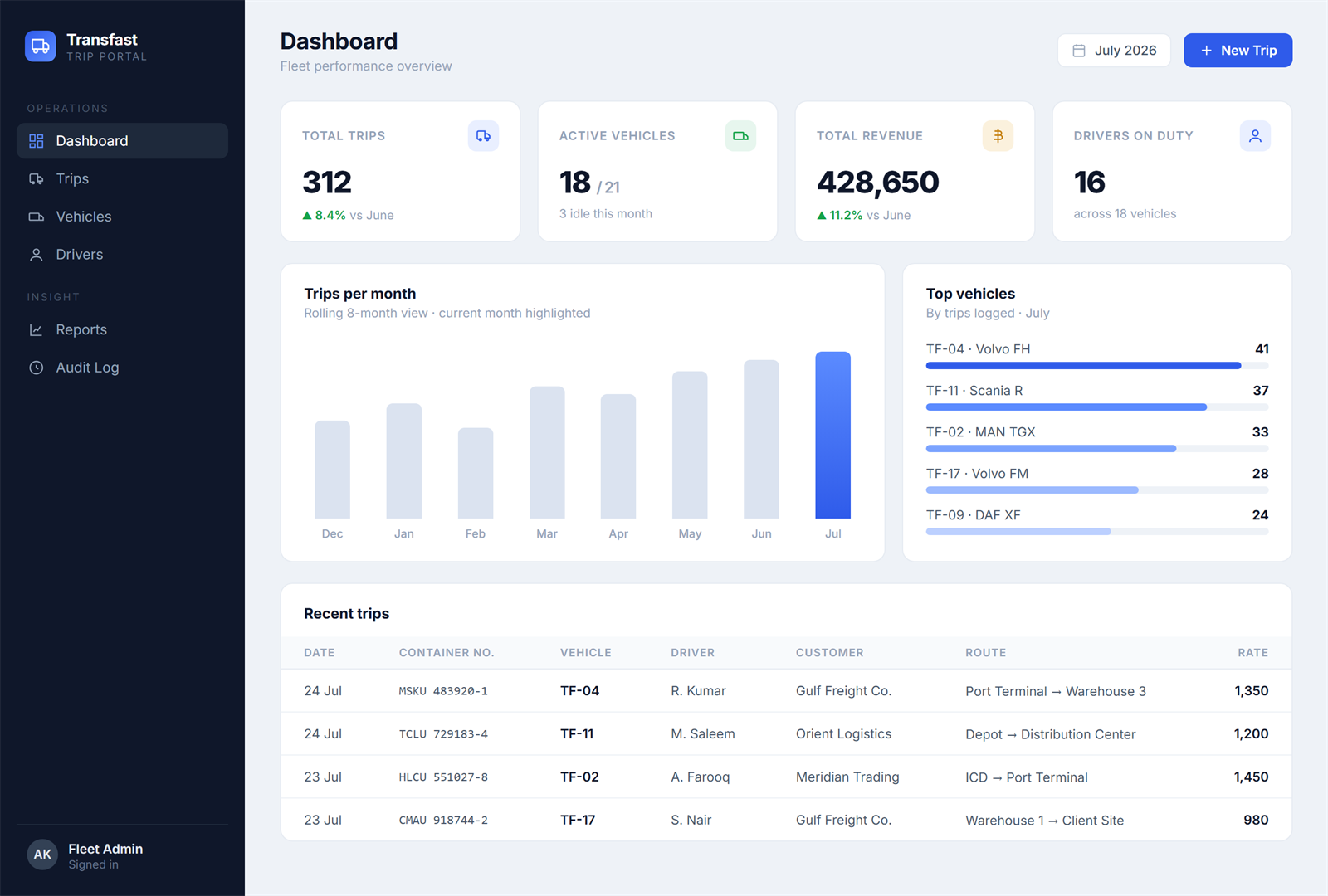
Transfast runs a fleet of trucks moving shipping containers between ports, depots, and customer sites. Every trip — date, container number, driver, customer, route, and rate — was logged by hand in Excel. It worked, until it didn't: every customer report meant rebuilding the same table from scratch, a corrected trip left no trace of what changed, and the data lived on one machine, invisible to anyone not looking at that spreadsheet.
The brief was deceptively simple — get off Excel — but the real constraint was adoption. The team knew their report cold. Any replacement that changed how the numbers looked would be fought, not used.
The solution
A serverless fleet-dispatch PWA that mirrors the business's exact original report layout — same columns, same TOTAL / TOTAL TRIPS footer — so nothing about reading a report changed. The only thing that changed was how the report gets produced: one click instead of an afternoon of copy-paste. Built end-to-end by a single Forzateks engineer, spec to production in under 25 hours.
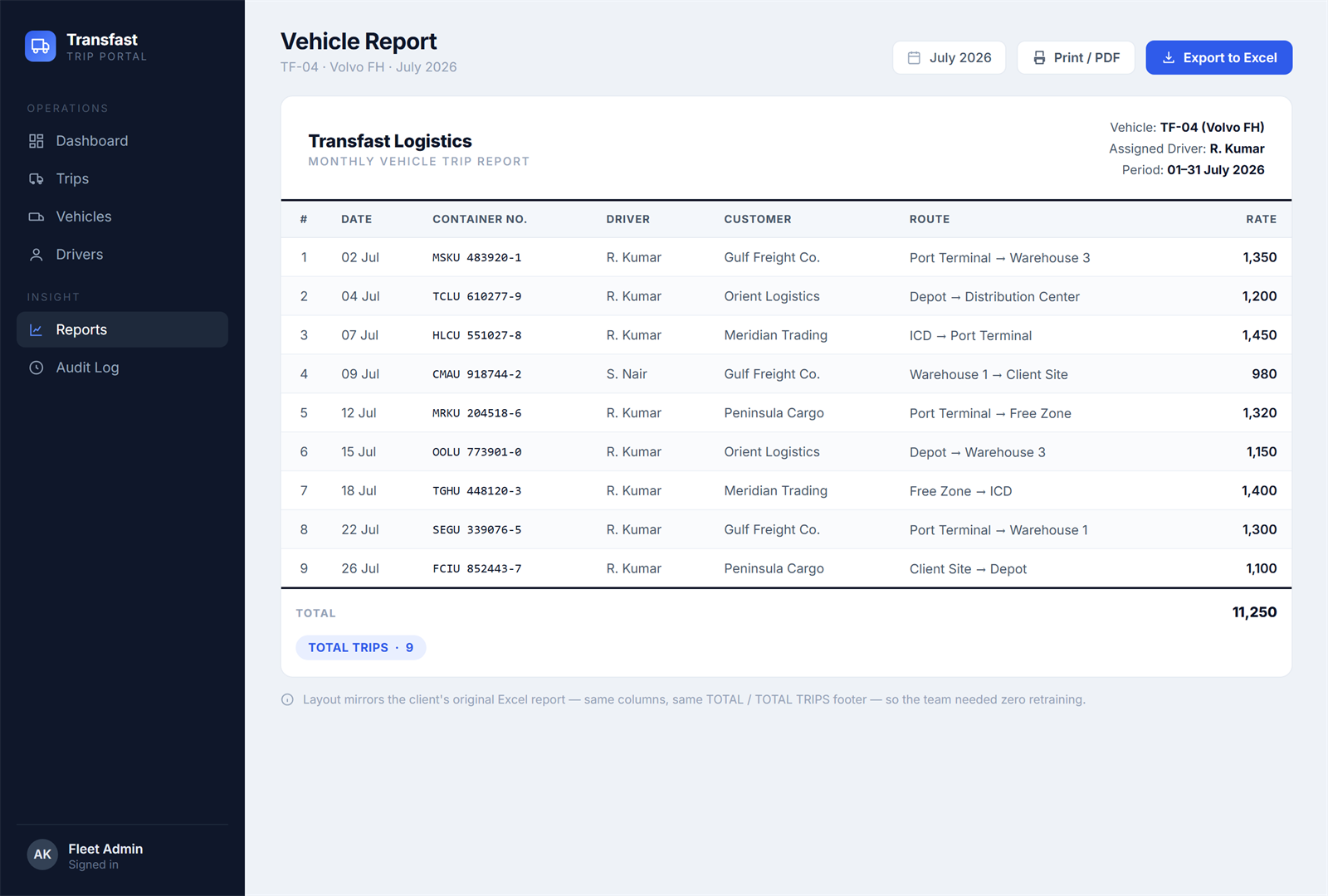
Zero-retraining reports
Vehicle reports reproduce the client's original Excel layout column-for-column, down to the TOTAL and TOTAL TRIPS footer — so the team read day one output exactly the way they always had.
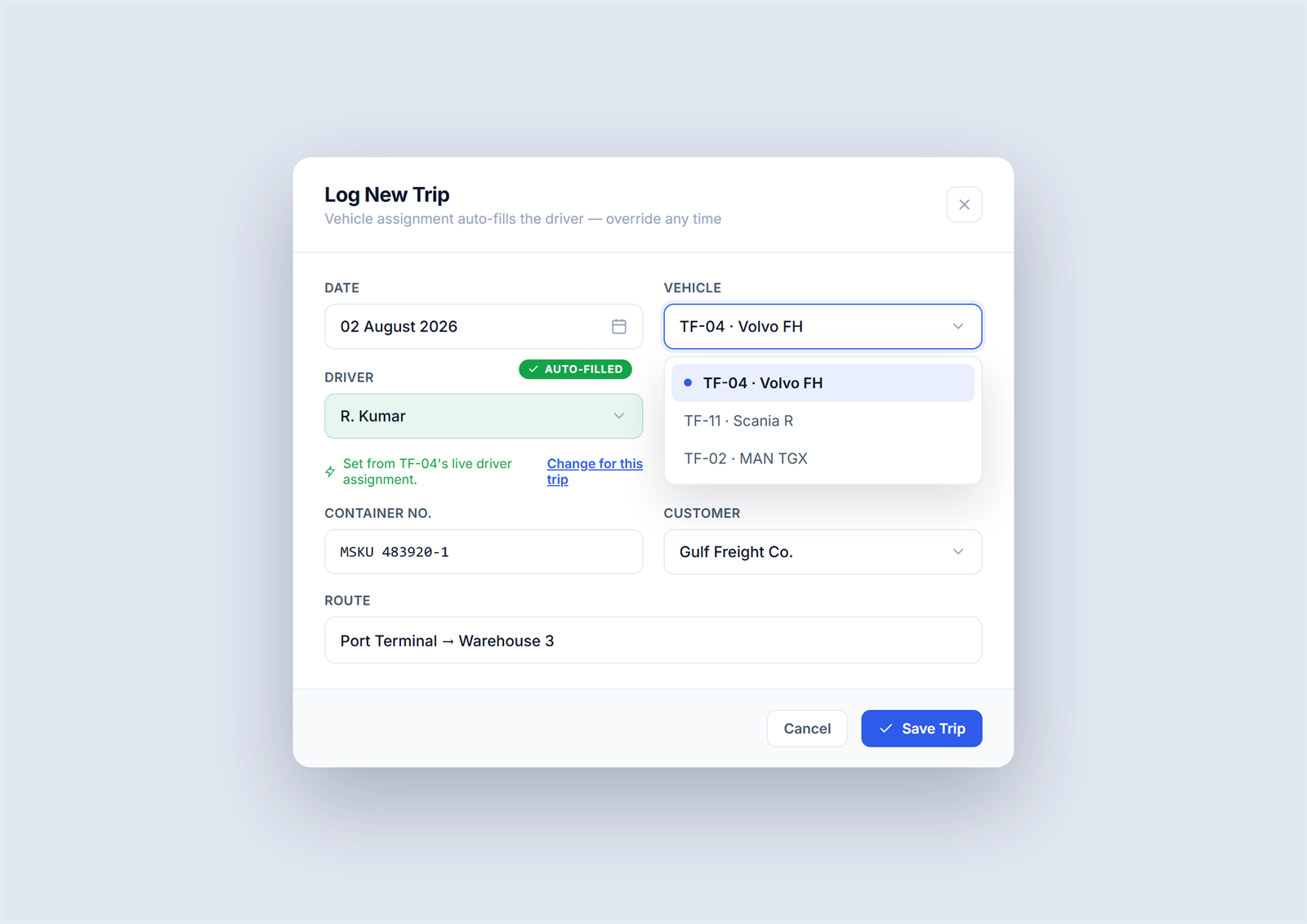
Vehicle → driver autofill
Each vehicle carries a live driver assignment that auto-fills every new trip the moment the vehicle is picked — overridable per trip when someone covers a shift. Fewer fields, fewer mistakes.
Excel export & print-to-PDF
Any vehicle report exports to a real .xlsx workbook (SheetJS) or prints straight to PDF — the two formats customers actually ask for, generated on demand instead of assembled by hand.
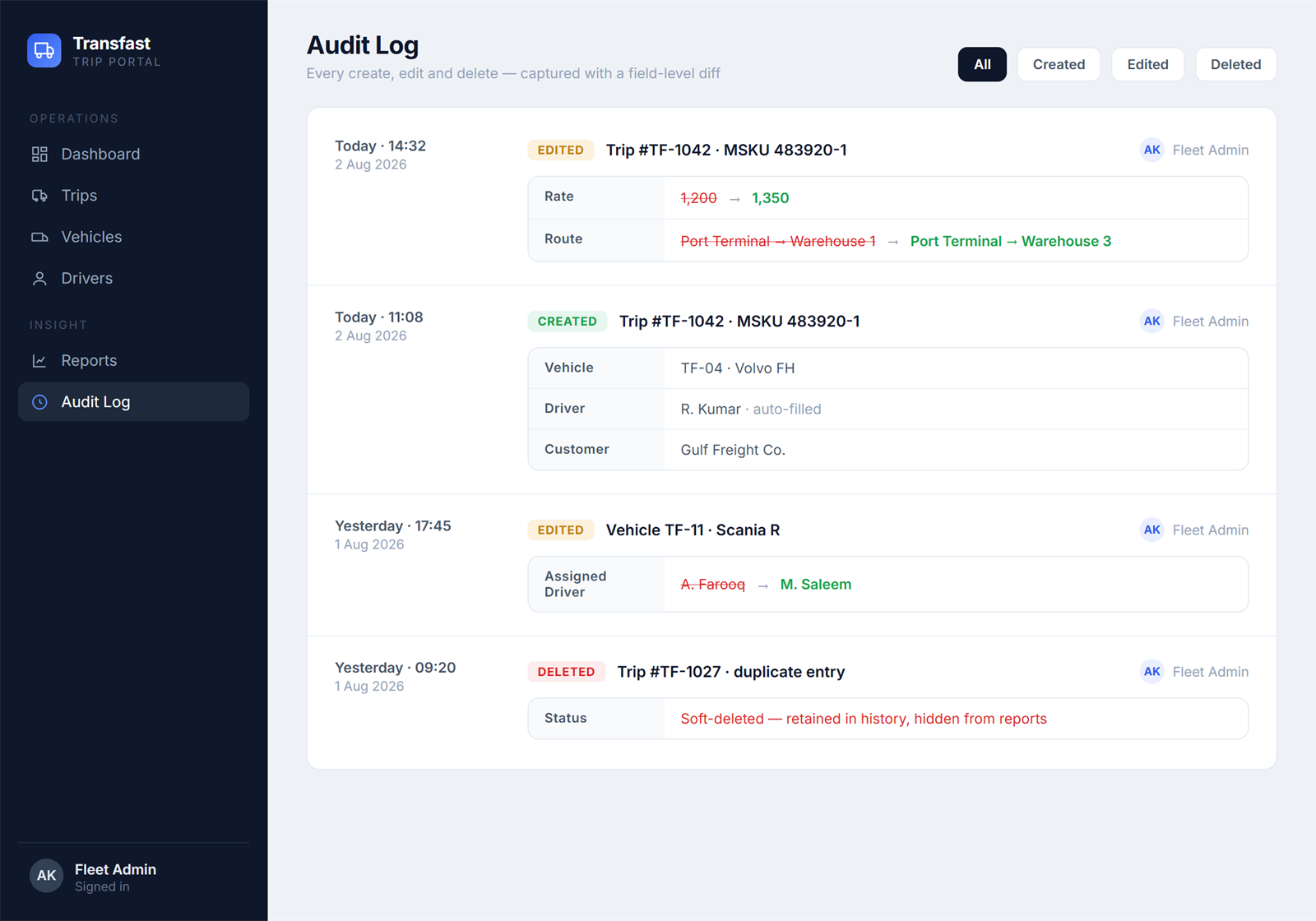
Field-level audit trail
Every create, edit, and delete is logged with a before/after diff of exactly which fields changed, when, and by whom — so a corrected rate is never a mystery again.
History-safe CRUD
Fleet and driver records use soft deletes: retiring a vehicle or driver never erases the trips tied to it. Past reports stay intact; the record simply drops out of new selections.
Installable, offline-first
Installs to the desktop like a native app, caches its data for offline reference, and guards access with signed session cookies — no heavyweight auth stack for a single-operator tool.
Architecture
The stack
A single-tenant app with no server to babysit: a React + TypeScript frontend built with Vite, a serverless API on Cloudflare Pages Functions, and Cloudflare D1 (SQLite) as the one source of truth — trips, vehicles, drivers, and the audit log all in one place. SheetJS handles Excel export; the trickiest logic — report totals, audit diffing, and session-cookie signing — is pinned down by ~2,700 lines of TypeScript and three Vitest suites, shipped across 20 focused commits.
 React
React
 TypeScript
 Vite
Vite
 Pages Functions
 Cloudflare D1
 Vitest
SheetJS · Excel
PWA · Offline
Vitest
SheetJS · Excel
PWA · Offline
Results
- Zero retraining — the report looks identical, so the team adopted it without a single how-to session.
- Reports on demand — a customer report is one click and an .xlsx, not an afternoon of rebuilding tables.
- Nothing lost in an edit — every correction is diffed and dated, and retired records never take their history with them.
- Live in production in under 25 hours — one engineer, full ownership from spec to deploy.
Screens shown are anonymized recreations of the production interface. Transfast is a private, single-tenant internal tool with real login and live fleet data — it isn't publicly browsable, but a walkthrough can be arranged for serious enquiries.
Still running the business out of a spreadsheet?
This replaced exactly that — fast, and without the team having to relearn a thing. If a manual Excel or WhatsApp workflow is quietly costing you time, the first conversation costs nothing.
Let's Connect →